

This article was published in Waterproof 2026 – 1.
Circular water in the polder
It has been a while since Lelystad Airport Businesspark (LAB) made national headlines in the Netherlands. Yet the project remains a striking example of how circular water systems can work in practice. At LAB, vacuum sewer systems and vacuum toilets play a central role in a circular water approach. Wastewater is collected efficiently, treated locally and reused on site — saving thousands of cubic metres of drinking water every year. It is exactly the kind of project that the Circular Water Expert Group of Water Alliance likes to sink its teeth into, especially as the Netherlands faces major challenges in sustainable urban development.
“OMALA (Ontwikkeling Maatschappij Airport Lelystad Almere, ed) deserves credit as the area developer for what has been achieved here,” says Joost Kreuger. In his day-to-day work he is a project leader at Qua-vac and also a member of the Water Alliance Circular Water Expert Group. The expert group focuses on accelerating the application of technologies that enable water to be reused in homes and businesses. Another goal is to increase the use of rainwater. Ultimately, these approaches aim to reduce not only drinking water consumption but also energy use in and around the built environment.
Kreuger has particularly good memories of the LAB project. “Together with partners such as WaterLab Circulair Water, Liander, Vitens and a range of companies, OMALA helped turn LAB into a true best practice in area development and circular water use,” he says.
For the technical realisation of the water chain, companies including Jotem, Rietland and Qua-vac joined forces. Rietland provided natural pre-treatment using its Phytoair system, Jotem handled purification through membrane and oxidation technology, and Qua-vac supplied the vacuum sewer systems.
Award for sustainable water use
The result is a system that enables water reuse for industrial processes and fire-fighting purposes, significantly reducing drinking water consumption and energy use while lowering wastewater discharge.
The project was previously recognised with the Sustainable Water Use Award from Vitens — an acknowledgement of circular thinking put into practice. “The project had several objectives,” Kreuger explains. “First of all, maximising the reuse of wastewater so that far less drinking water is required. But with this case we also wanted to show that a scalable and reproducible area-based approach is possible for other business parks as well.”
Economies of scale
With the major construction and development challenges the Netherlands faces in the coming years, it makes sense to look at integrated circular water solutions, Kreuger says on behalf of the expert group. “You can achieve economies of scale when you stop thinking in terms of solutions per building and instead develop an integrated system for an entire area. That is what we did at LAB.”
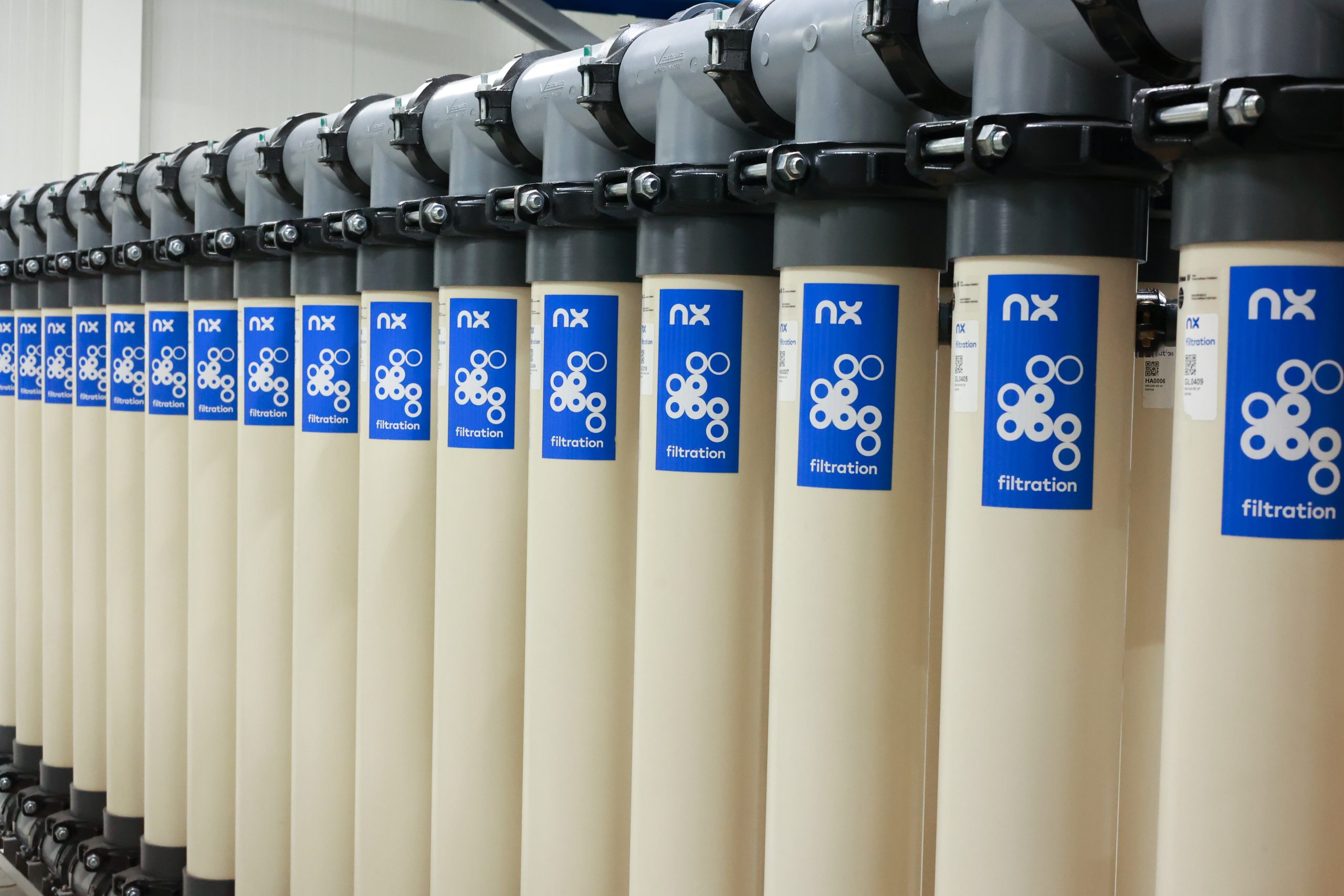
The approach also ensured that water across the entire site can be reused. One of the key elements was Rietland’s natural pre-treatment technology, which requires less energy and fewer chemicals. In addition, nano-filtration and UV/H₂O₂ oxidation from Jotem allow part of the treated water to be upgraded to a quality suitable for use as fire-fighting water or industrial process water.
Vacuum sewer systems
Dennis Meerburg, business developer at LAB, looks back on the project with great satisfaction. “We save large amounts of drinking water here by collecting wastewater efficiently and then treating the greywater on site,” he says. “The remaining toilet water is transported through narrow pipes at high speed using pressure differences and a small amount of water — somewhat comparable to the systems used in aircraft.”
Because of this system, wastewater transport becomes more compact and requires significantly less energy.
WaterLab Circulair Water
With the ambitious construction plans ahead for the Netherlands, Lelystad Airport Businesspark is a strong example of how circular water technology can contribute to sustainability at business parks.
In 2025 LAB received national recognition by winning the first Sustainable Water Use Award for Business, presented by Vitens.
One striking figure: when fully developed, the use of vacuum toilets combined with vacuum sewer systems at LAB is expected to save more than 100,000 cubic metres of water per year — roughly the equivalent of 40 Olympic swimming pools.
Collaborations such as the one behind LAB are relatively easy to establish thanks to the network of Water Alliance. Within the organisation, more than 200 Dutch water technology companies share knowledge through ten thematic expert groups. For companies, this model not only facilitates knowledge exchange but also helps them initiate joint projects.